News From Scotland
Article Links
[accordion_toggle title=”A Wee Dram?”]
How about 9120 drams – all in one bottle – that’s over 60 gallons!
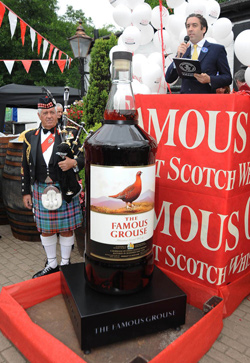 The bottle stands 5’5″ tall and is filled with Famous Grouse whisky. Bottle after bottle was poured in by hand, taking more than three hours to fill! Fomous Grouse is now in the Guinness Book of World Records for the biggest bottle of whisky. It was part of their 107 anniversary celebration. The bottle will be on permanent display at the Glenturret Distillery in Crieff.
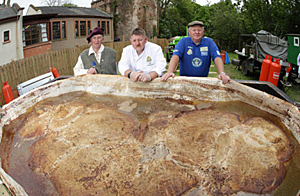 It would have gone well with the world’s largest haggis, made in Mauchline, Ayrshire. The haggis weighed in at about 1200 pounds. The big challenge was cooking it and lifting it without splitting the skin!
[/accordion_toggle]
[accordion_toggle title=”Edinburgh University and the Higgs Boson”]
[/accordion_toggle]
[accordion_toggle title=”Prince William installed as Knight of the Order of the Thistle”]
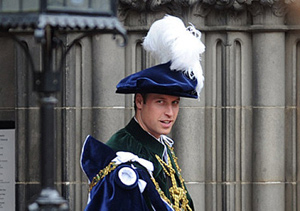 The most ancient and most noble Order of the Thistle is the highest honor Scotland can bestow. It is the Scottish equivalent of the Order of the Garter, but fewer people are installed into the Order of the Thistle. The number of knights is limited to 16, and a new one is appointed whenever a knight passes away.
Prince William joins family members already in the order: HRH Queen Elizabeth II, HRH Prince Charles Prince of Wales, HRH the Duke of Edinburgh, and the HRH Princess Anne Princess Royal.
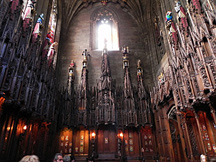 The ceremony took place in one of Edinburgh’s best-known landmarks, the Chapel of the Order of the Thistle, in St. Giles’ Cathedral. The chapel was only recently added to St Giles’ Cathedral, just over a century ago, but it is one of Scotland’s most breath taking architectural treasures.
[/accordion_toggle]
[accordion_toggle title=”Elizabeth Bowes-Lyon – The Queen Mum”]
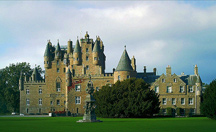 herself came from Scottish nobility, growing up in Glamis Castle, as daughter of the 14th Earl of Strathmore and Kinghorne. She was also related to the Duke of Wellington, who defeated Emperor Napoleon. Her mother was descended from a British Prime Minister William Cavendish-Bentinck, and a Governor-General of India, 1stMarquess of Wellesley, who was the elder brother of that famous Duke of Wellington.
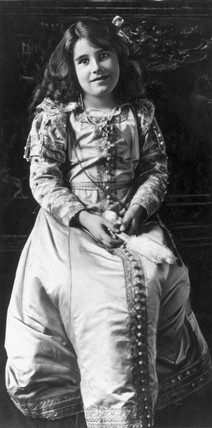 She was educated by a governess until the age of eight. When she was fourteen, Britain declared war on Germany. Four of her brothers served, and her elder brother, Fergus, died as an officer in the Black Watch Regiment. Another brother was captured and held as a POW until the end of the war. Glamis Castle was turned into a convalescent home for wounded soldiers, which the future Queen helped run. One of the soldiers she treated wrote in her autograph book that she was to be “Hung, drawn, & quartered … Hung in diamonds, drawn in a coach and four, and quartered in the best house in the land.”
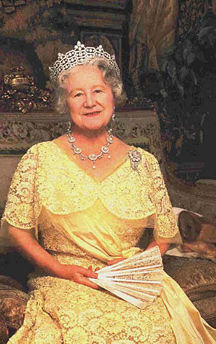 A typical Scot, she was famous for her strong principles, physical courage and sense of duty. Peter Ustinov wrote of her facing a student riot at the University of Dundee in 1968. When students were throwing toilet rolls like streamers, she got out of her car, picked one up, and approached the student who’d thrown it. “Was this yours? Oh, could you take it?” The student was dumbfounded, and the mob quieted and backed away.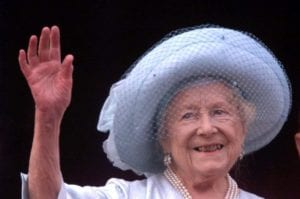
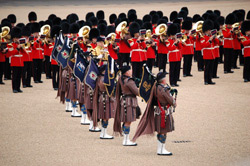 As Army Cadet of the Year, I had the honor and pleasure of being presented to the Queen Mother at a garden party in Buckingham Palace – and she was every bit as others have described her – a true Scot – interested – chatty – hospitable – unassuming – a genuinely charming lady. Among all the uniforms there that day – the Royal Marines Band – the Regiment of Guards – she noticed my hodden grey uniform and came over to chat. Hodden grey, the tartan of the London Scottish Regiment, came from the tartan worn by the common folk in Scotland – made from blending one strand of black wool to twelve of white before weaving – and made famous in Burns’ “A Man’s A Man For A’ That”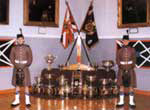
[/accordion_toggle]
[accordion_toggle title=”Mary Queen of Scots – The First Soccer Mom?”]
[/accordion_toggle]
[accordion_toggle title=”Shedding Light on the Dark Ages”]
[/accordion_toggle]
[accordion_toggle title=”The Stone of Destiny may be from Irvine, not Scone”]
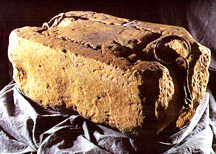 The Stone of Destiny – that ancient royal seat of Scotland, where kings were crowned -may be the Stone of Irvine. One thing is sure, it has moved around a lot in its history. Legend has it being taken by Jacob while in Haran. Legend also has it being brought from Ireland by the Dalriata gaels when they settled Scotland. More likely is the story of Fergus, son of Ferchard, the first King of the Scots in Scotland, bringing the Stone from Ireland to Argyll, where he was crowned on it.
[/accordion_toggle]
[accordion_toggle title=”There’s An App for that!”]
The Scottish Government has launched a free iPhone app which contains the entire works of the Bard – over 550 poems and songs! Culture Minister Fiona Hyslop called the new app “a great platform” to promote Burns. She said: “Robert Burns is Scotland’s greatest cultural icon, recognized and celebrated all around the world. His legacy is of incalculable value to Scotland and the country’s image abroad.” If you have an iPhone, free downloads are available – just in time to be a silent prompt for that Burns Night speech, and that awful moment when your mind goes blank over a poem you’d remembered your whole life!
[/accordion_toggle]
[accordion_toggle title=”A Dram in a Can?”]
A Dram In A Can? Oh no! What’s the world coming to? Scotch whisky connoisseurs are up in arms over “Sir Edwin’s tinned whisky”! It’s being sold in the Caribbean and in South America. But hold onto your kilt! You don’t need to panic just yet! The company producing Sir Edwin’s, Scottish Spirits, is based in the Highlands. It’s in Panama. And the CEO bears the well-known Scottish family name of Manish Panshal!
Somehow I don’t think the single malt business is about to disappear. Besides, a can of Sir Edwin’s holds only three shots – hardly enough for the serious drinker (unless some airline serves it on very short flights!)
[/accordion_toggle]
[accordion_toggle title=”EU Funding for Highlands and Islands”]
The Highlands and Islands are to receive £18m in EU cash aid from the European Regional Development Fund. These funds are to assist the area in tourism and renewable energy.
More than £1 million will go to a visitor center for the chambered tomb of Maeshowe on Orkney, and the Highlanders Museum Redevelopment Project near Inverness will get almost £1 million. The Highlanders Museum has been generously funded by actor Hugh Grant, who has raised money for it in honor of his grandfather Colonel James Murray Grant, who was a senior officer at a nearby artillery fort. This museum has a military flavor, and is dedicated to the Seaforth Highlanders, the Queen’s Own Cameron Highlanders, and the Queen’s Own Highlanders.
[/accordion_toggle]
[accordion_toggle title=”University of the Highlands and Islands”]
This university is set to join other Scottish universities in the new year. It has met the standards required for institutions of advanced learning. The final decision will be made in the near future by the Privy Council of the Scottish government. UHI colleges are currently scattered throughout the Highlands and islands, in such places as: the Orkneys; Shetlands; Lews castle; Moray; Ostaig; Inverness, Perth; and Argyll.
[/accordion_toggle]
[accordion_toggle title=”New Robert Burns Birthplace Museum”]
The museum contains 5000 artifacts from Burns’ life, including manuscripts and personal items like a piece of Jean Armour’s wedding dress. The museum is an attempt by the National Trust for Scotland to bring together other Burns’ sites, including the Burns’ National Park, the Burns’ Monument, Alloway Auld Kirk, Burns’ Cottage, and Auld Brig o’Doon. The NTS hopes to attract 80,000 visitors a year to learn more about the national bard. For more information, go to: Scotsman.com -Heritage & Culture.
[/accordion_toggle]
[accordion_toggle title=”Desperate Fishwives!”]
This new series is moving from radio to BBC II Scotland. You probably won’t be able to watch it here yet (it takes a while for these wonderful Britcoms to reach here), but it sounds great. Characters like Jim and Jock, Mither and Faither, and Man’s Man, fill this comedy sketch show set against the spectacular backdrop of North Eastern Scotland.
Mither and Faither’s life looks like it should be idyllic. The kids have left home, they can afford good holidays and although now middle-aged they are still comfortably in love. Everything is fine, except for two annoying things – their friends Selma and Eddie. Jim and Jock are farmer and farm labourer respectively, both live in the “Brig O Doon” village of Meiklewartle where they have decided to set up a community television station, MTV Meiklewartle Television. They are assisted by the village wench / camera person Feel Moira (Mad Moria) so the pictures are a wee bit wobbly. If you can’t watch it yet, try keeping up-to-date on Desperate Fishwives on www.facebook.com.
[/accordion_toggle]
[accordion_toggle title=”Islay Leads The World”]
[/accordion_toggle]
[accordion_toggle title=”My Heart’s In The Highlands, My Heart Is Not Here”]
You know about watching a politician’s lips. How about watching his fingers? Scottish domination of British politics is a tradition (just look at the nine Prime Ministers who’ve served under Queen Elizabeth II: with MacMillan, Douglas-Home, Blair, Gordon Brown and now David Cameron), its only to be expected that the current Speaker of the House of Commons would be a Scot. Michael Martin, representing Glasgow North-East, is known to drift off during long debates. But what is he really doing? The answer has just come out. He’s secretly playing his pipes! He confessed during a recent interview that he’s practicing his fingering! “People ask me, isn’t it the case that the debates are boring? How do you survive? I answer that if I have a pen and my fingers are moving, that’s my way of switching off from what’s being said.”
[/accordion_toggle]
[accordion_toggle title=”Ancient Chanter Comes Home After 200 years”]
A priceless chanter from the 1600s is being returned to its native land after more than 200 years in exile. The chanter once belonged to the legendary Blind Piper of Gairloch, Iain Dall MacKay, who was born at Talladale on Loch Maree and trained as a piper on Skye. MacKay (1656-1754) was a true Gaelic bard. He was not only a piper, but he also accompanied his poetic songs on the harp. But it’s his piobaireachd compositions that established his reputation as one of the greatest pipers who ever lived. His descendant, John Roy MacKay emigrated to Nova Scotia in 1805 and took the chanter with him.
The chanter remained there until St. Andrew’s Day 2010, when the current owners (brothers Donald and Michael Sinclair, related to the MacKay family) decided it should be returned to its homeland. It is now on display at Glasgow’s National Piping Centre. Dr Hugh Cheape, a former curator at National Museums Scotland and a student of bagpipe history, said: “To think that these timeless pieces of music were possibly composed and played on this very chanter will be awe-inspiring for fans of the tradition.” Lady Oona Ivory, founder and vice-chairwoman of the National Piping Centre, added: “We are delighted that this donation is going to be housed in the National Piping Centre. It will enhance the exhibition, which already contains many interesting and wonderful artifacts that allow us to understand our rich piping heritage.”
But not everyone is happy. Dr. John Gibson, a piping scholar in Cape Breton, believes the transfer breaks Canadian heritage law, which forbids the export of national treasures. He has taken legal advice to get it back.
[/accordion_toggle]
[accordion_toggle title=”Whisky Galore With A Twist”]
It wasn’t washed ashore from a shipwreck, but it may have gone down the drain. The heavy snows last winter caused some of the Glenfiddich warehouse roofs to collapse, exposing the oak maturing casks. Imagine the horror, the sheer panic! It sounds a bit like “Whisky Galore” revisited. With temperatures at minus 19C, the workers at Glenfiddich had to leap into action and work round the clock to save the precious brew. Exposed casks were rescued, and the whiskey was moved to new casks (some made of American Oak). This rescue operation has resulted in a new single malt called “Snow Phoenix”, which is dedicated to Scotland’s Mountain Rescue – and available to the public at £49.99 a bottle.
[/accordion_toggle]
[accordion_toggle title=”A Free Genealogy Resource”]
www.Scotlandspeople.gov.uk offers free surname searches from the government records dating back to 1513.
The web site www.AncestorsOnBoard.com offers passenger lists for voyages leaving Britain from 1890-1960 with images available to download, view, save and print.
[/accordion_toggle]